
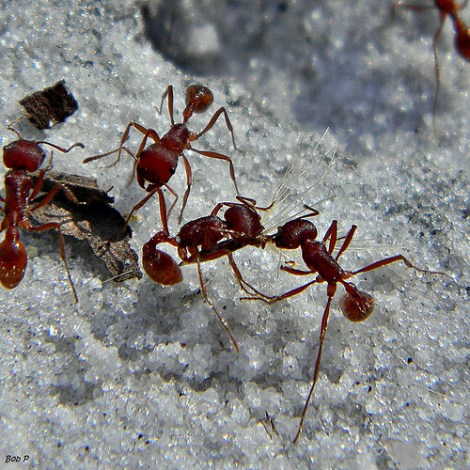
Photo by bob in swamp.
Step aside, Al Gore. You, too, Tim Berners-Lee. Now we know who really invented the internet: ants.
“Invented” is maybe not exactly right. It’s more like they independently discovered one of its fundamental principles. Sort of like Newton and Leibniz and calculus, except that it’s quite clear who discovered this particular algorithm first. (Hint: It wasn’t us.)
The fundamental principle in question has to do with maximizing the use of a scarce resource. In the case of the internet, that resource is bandwidth. In the case of ants, it’s food. Here’s how it works, according to Stanford University, where biology professor Deborah Gordon has been studying harvester ants:
A forager won’t return to the nest until it finds food. If seeds are plentiful, foragers return faster, and more ants leave the nest to forage. If, however, ants begin returning empty handed, the search is slowed, and perhaps called off.
Similarly, when a Transmission Control Protocol algorithm seeks to send information, it sends out “foragers” with packets of data. Those signals won’t return back to their origin until they find enough bandwidth. If there’s more bandwidth available, they’ll come back faster.
Gordon and Balaji Prabhakar, a colleague in the computer science department, worked to write a “TCP-influenced algorithm” to describe ants’ foraging behavior. Experiments confirmed that the ants worked just as systematically as they had predicted. Prabhakar explained it like this:
Ants have discovered an algorithm that we know well, and they’ve been doing it for millions of years.
Hmph. But did they come up with lolcats? Thought not.


