Uncategorized
All Stories
-
Scientists and journalists team up to get the climate story straight
What do Weather Channel seductress Heidi Cullen, Steven "wedge" Pacala, former TIME writer Michael Lemonick, soon-to-be NOAA head Jane Lubchenco, and Grist founding board member Ben Strauss have in common?
They're all part of an new project called Climate Central. It was mentioned briefly in this recent post about Lubchenco, but it's so interesting and innovative that it merits further digital ink -- which I was going to provide myself, but Curtis Brainard of the Columbia Journalism Review beat me to it.
Climate Central is a hybrid team of nearly two dozen journalists and scientists -- spread between a main office in Princeton, New Jersey and a smaller one in Palo Alto, California -- who work side by side on stories for television, print, and the Web. Relying upon a non-profit business model that is similar to The Center for Investigative Reporting, ProPublica, and others, Climate Central pitches its work to local and national news outlets, looking for collaborative editorial partnerships. It also makes its various experts, many of who are still affiliated with major research institutions, available as primary sources. The goal is to "localize" the story around regions, states, or even cities, in order to highlight the various and particular ways that changes in climate are affecting people's daily lives.
As Brainard points out, this new effort comes at a time when traditional news outlets are struggling to produce original environment-related content (many, like CNN, have axed their science and environment teams).
Whether Climate Central will be, as communications scholar Matthew Nisbet puts it, "the future of science journalism -- non-profit partnerships providing independent and syndicated science coverage," or whether it will falter under conflicts of interest (real or perceived), remains to be seen.
But it's great to see scientists stepping up to the plate -- or if you'll indulge a double-edged pun -- to the green screen.
-
Despite continued shenanigans, prospects looking up for Mass. wind project
The final environmental impact statement on Cape Wind was supposed to hit the press in December, but it's been put back another month thanks to the delay tactics of the 'antis' in Congress, this time notably Rep Jim Oberstar (D-Minn) who was recently singled out in Grist as an outstanding advocate for progressive stances on energy and transit, but only in Minnesota, I guess. The Providence Journal takes him and those he probably acted on behalf of to task here:
This is another win for the Kennedys, who have summer houses on Nantucket Sound, and Bill Koch, a fossil-fuel billionaire and a hardball political player and paymaster, and the leader of the anti-wind-farm group the Alliance to Protect Nantucket Sound ... That the vast majority of Massachusetts residents support Cape Wind seems not to matter at all ...
The FEIS is expected to be very positive on the proposal, opening the way to who knows what next hurdle the Alliance will erect, 7 years now after Cape Wind was first proposed.
-
-
World's biggest solar power tower to open in Spain
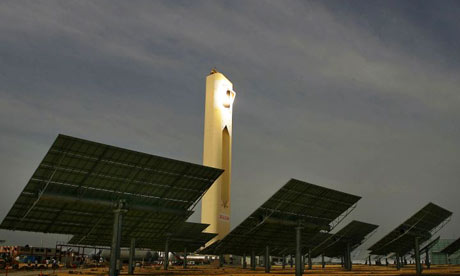
The world's biggest solar tower will open early this year in Spain. The race for leadership in the next generation of solar power is taking off.
The U.K. Guardian reports that in the desert 20 miles outside Seville, the Spanish company Abengoa will be deploying over 1,000 sun-tracking mirrors -- each "about half the size of a tennis court" -- to superheat water to 260°C to drive a steam turbine and generate 20MW of electricity.
Concentrated solar power (CSP) technology, as it is known, is seen by many as a simpler, cheaper and more efficient way to harness the sun's energy than other methods such as photovoltaic (PV) panels.
Spain is placing a huge bet on CSP to meet their renewable energy and carbon targets:
-
Who do we repay for the pollution from which we have benefitted?
If I buy bread from you, when you want to sell it to me, and we agree on a price, that's a deal between the two of us. Now imagine that you getting up early to bake bread wakes two people who would rather sleep in. They are not a factor in our deal -- they are "external" to our market exchange and any effect on them is an "externality" we have ignored in agreeing on our price. The same logic holds for the greenhouse gases your ovens generated when you baked the bread. That contribution to climate change is an "environmental externality."
How many of those did you create today?
-
Friday music blogging: Murs
ListenPlay "The Science," by MursMurs is a prolific underground rapper out of L.A. He's been around for over 15 years now, as part of at least five hip-hop groups and, recently, as a solo artist. He's something of a legend in the indie rap world.
His latest album, Murs for President, is a doozy. In particular, this song, "The Science," seems to sum up basically everything there is to know about rap. I guess there aren't many hip-hop fans around here, but this one's worth listening to for the lyrics alone.
-
Scientists and other experts rattle off options for averting climate catastrophe
London’s Independent newspaper asked climate scientists to answer a simple question: should humanity “prepare a ‘Plan B’ to curb the worst effects of global warming?” Well, ask 40 eggheads a […]
-
Eco-buzzwords make annual banned words list
Hush your mouth, eco-child: That green buzzword you were about to utter is probably on Lake Superior State University's annual list of banned words. "Green" itself topped the list, with it or "going green" garnering the most nominations. True that. Please, no more press releases titled "Midwives/Fighter Jets/Port-o-Potties Go Green!"
"Carbon footprint" also made the 34th annual List of Words to Be Banished from the Queen's English for Mis-use, Over-use and General Uselessness. And as for "staycation," Dan Muldoon of Omaha, Nebraska, commented with his nomination, "Let's send this word on a slow boat to nowhere."
-
Regulation and public investment are more efficient means to reduce GHGs than emissions pricing
When I sat down to write about why so-called "command and control" methods are often the most effective and efficient means of fighting climate chaos, I found that Kevin Drum had posted exactly the argument I wanted to refute.
After conceding that it will take more than emissions pricing to lower greenhouse gas emissions, and that response to price signals tends to be small and slow, Drum argues that a price mechanism should be the primary means to fight climate chaos: "Still, generally speaking, taxes and carbon trading are more efficient regulatory mechanisms than command and control, so the more you can rely on them the better."
I think this default conventional wisdom is just plain wrong. Not only is elasticity low, but there are also simple standards by which we can measure energy and greenhouse-gas efficiency. Further, suitable means for increasing efficiency and lowering emissions are known. Given these three conditions, price is not the most efficient way to change behavior.
As examples, consider weather and duct sealing. It's widely acknowledged that sealing buildings yields fast paybacks -- two years or less. Yet most buildings remain under-sealed, with leaky frames and ducts. How do we change this? Well, we can raise the price of energy until people become desperate and seek out contractors. But since we already have quick paybacks, any amount we raise the price is far beyond the cost of saving the energy.
If, as I have suggested in surveys of the literature, demand response to price increases is around -.5, that means it will require $200 in emissions charges to motivate each $100 of consumer investment in energy efficiency. In contrast, investing public funds could insure that a nice woman working for an energy-efficiency utility could seal your home for around $100, plus a bit for administration. Even if that $100+ came from regressive taxation, it would still cost consumers less than a primarily price-driven policy. And if the payback is really two years or less, the government could use its ability to borrow to provide low interest financing, thus bringing the cost to consumers down below the business-as-usual price.
-
An open letter to the president and first lady from the nation's top climate scientist
29 December 2008
Michelle and Barack Obama
Chicago and Washington, D.C. United States of AmericaDear Michelle and Barack,
We write to you as fellow parents concerned about the Earth that will be inherited by our children, grandchildren, and those yet to be born.
Barack has spoken of "a planet in peril" and noted that actions needed to stem climate change have other merits. However, the nature of the chosen actions will be of crucial importance.
We apologize for the length of this letter. But your personal attention to these details could make all the difference in what surely will be the most important matter of our times.
Jim has advised governments previously through regular channels. But urgency now dictates a personal appeal. Scientists at the forefront of climate research have seen a stream of new data in the past few years with startling implications for humanity and all life on Earth.
Yet the information that most needs to be communicated to you concerns the failure of policy approaches employed by nations most sincere and concerned about stabilizing climate. Policies being discussed in national and international circles now, which focus on 'goals' for emission reduction and 'cap and trade,' have the same basic approach as the Kyoto Protocol. This approach is ineffectual and not commensurate with the climate threat. It could waste another decade, locking in disastrous consequences for our planet and humanity.
The enclosure, "Tell Barack Obama the Truth -- the Whole Truth" [PDF] was sent to colleagues for comments as we left for a trip to Europe. Their main suggestion was to add a summary of the specific recommendations, preferably in a cover letter sent to both of you.
There is a profound disconnect between actions that policy circles are considering and what the science demands for preservation of the planet. A stark scientific conclusion, that we must reduce greenhouse gases below present amounts to preserve nature and humanity, has become clear to the relevant experts. The validity of this statement could be verified by the National Academy of Sciences, which can deliver prompt authoritative reports in response to a Presidential request1. NAS was set up by President Lincoln for just such advisory purposes.
Science and policy cannot be divorced. It is still feasible to avert climate disasters, but only if policies are consistent with what science indicates to be required. Our three recommendations derive from the science, including logical inferences based on empirical information about the effectiveness or ineffectiveness of specific past policy approaches.
