Uncategorized
All Stories
-
Robert Stavins can't walk and chew gum at the same time
One of my New Year's resolutions is to blog more about the general lameness of the economics profession when it comes to energy and climate issues. (Note to self: How about losing a few pounds?)
I was in the midst of putting this resolution off for a few weeks when I saw a quote by Robert Stavins that seemed to sum up the value-subtracted that economists bring to the world.

In an otherwise excellent New Yorker article on Van Jones' efforts to push a green jobs agenda, which I will blog on separately, Elizabeth Kolbert feels compelled to "balance" Jones with some people who don't think it's a good idea to simultaneously address the climate problem and the poverty/jobs problem. Who else could a respectable journalist turn to than an economist, a profession that arguably has cost the country and the world more jobs than any other?
Indeed, I remember Bill Clinton opining at a Georgetown conference in 1997 on why he ignored the advice of Administration economists, like Larry Summers, who urged him not to adopt a serious greenhouse gas emissions target at Kyoto. Clinton said his economic team had assured him that his balanced budget plan would be a job killer, so he pretty much took everything they said from that point on it with a grain of salt. But I digress.
Kolbert manages to elicit this amazing response from one of our leading economists:
-
Friday music blogging: Ladyhawk
ListenPlay "Fear," by LadyhawkI'm in a rush here -- got an actual date with my wife tonight! -- but real quick: here's a song from a Canadian indie band called Ladyhawk, who combine rootsy twang with Hüsker Dü-esque wailing. I'm in love with this song and recommend the album, Shots, highly.
(Or download the album as mp3 files.)
-
New York governor calls for green jobs, renewable energy, and energy efficiency to stimulate economy
President-elect Barack Obama isn't the only elected official talking about using green jobs to stimulate the economy -- the theme is echoed in state houses as well. On Wednesday, New York Governor David Paterson (D) gave his State of the State (the acronym SOS fits so well), a sober assessment of the economic challenges facing the state followed by a call to action that includes, among other things, an ambitious investment in renewable energy and energy efficiency to "help rebuild our economy, meet our energy needs, and protect our environment." (The 45 percent by 2015 goal he references almost certainly includes pre-existing hydro.)
But in Albany, as everywhere else, talk is cheap, and the governor is going to need the the help of the legislature and the Public Service Commission to get anything done. If you live in New York and would like to let policymakers know that you support the Governor's call to action, you can take action here.
-
New study: Efficiency investment better for Virginia economy and ratepayers than coal plant
You may or may not be aware of the huge ongoing fight in Virginia over the proposed Dominion coal-fired power plant in Wise County. Suffice to say, it's huge. And ongoing.
Into the fight drops a new report by ABT Associates, an independent research firm, which finds that -- surprise surprise -- efficiency is a far smarter investment:
The report compares the economic effects of building Dominion Power's Wise County coal plant with investing in energy efficiency measures that would meet the same electricity demand. The study finds that avoiding construction of the coal plant by investing in efficiency would save the average household in Dominion's service territory between $52 and $91 per year in 2012.
The report goes on to find that efficiency investments would also add far more revenue to the state economy and create thousands more jobs.
Got that? Better for the state economy, for ratepayers, and for jobs.
Now check out the first comment under this story about the report in a Virginia newspaper:
-
NASA: China's pollution control efforts improved air quality during the Olympics
Over at the Atlantic, James Fallows noted a NASA study, presented at the December meeting of the American Geophysical Union, that shows that China's efforts to clean up the air pollution during the Olympics did improve air quality.
Though the reductions in air pollutants seems to be specific to the Beijing area, the report noted:
During the two months when restrictions were in place, the levels of nitrogen dioxide (NO2) -- a noxious gas resulting from fossil fuel combustion (primarily in cars, trucks, and power plants) -- plunged nearly 50 percent. Likewise, levels of carbon monoxide (CO) fell about 20 percent.
The release that accompanied the report noted that the "steep decline in certain pollutants surprised the researchers," and in all fairness, it surprised me too. My coverage of the Beijing air was decidedly pollution-heavy. Though it's hard for me to swallow that Beijing may have gotten the air-pollution measures right -- an API of 95 is bad no matter how you spin it -- I couldn't agree more with Fallows:
... it shows that corrective steps can improve even the most hopeless-seeming environmental disasters. It's worth trying to do something, rather than just hunkering down in bed and trying to take very, very shallow breaths -- my strategy in the months from April to July.
In other words, Yes We Can.NASA images below the fold:
-
Massive flooding in western Washington linked to man-made causes
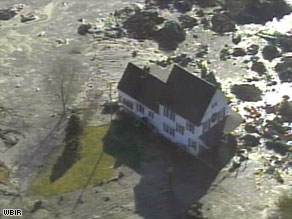
After digging itself out of "Snowmageddon" over the holidays, western Washington was hit with heavy rainfall this week, causing massive flooding. Roads, including major arteries like I-5 (pictured above), are closed and entire neighborhoods evacuated.
Sure, Seattle's known for its rain, but this is ridiculous! So who's responsible? Well, us, it turns out.
Scientists say a man-made triple whammy of logging, development, and climate change are to blame. And we shouldn't be surprised ...
A year ago (almost to the day), University of Washington geologist David Montgomery issued a warning to state legislators about the flooding that ravaged the region in 2007:
-
Question of the day
Why does Rex Tillerson, CEO of Exxon-Mobil, want a carbon tax?
Raise your hand if your answer is: because he sincerely thinks that is a more effective way to achieve the substantial emission reductions required to forestall catastrophic climate change.
-
TVA says leak has stopped but 'some materials flowed into Widows Creek'
You can't out-irony real life. The Tennessean has the story:
TVA is investigating a leak from a gypsum pond at its Widows Creek coal-burning power plant in northeastern Alabama ...
Seriously, Widows Creek coal plant? What PR guy thought that up? The same genius behind Frosty the Coalman, Clean Coal Night, and Deck the Halls with Clean Coal?
TVA says the leak has stopped, but not before "some materials flowed into Widows Creek." At least they won't have to change the creek's name. The story continues:
Gypsum is a byproduct of coal-burning power plants when "scrubbers" are added that use limestone spray to clean air emissions. This pulls sulfur dioxide from the emissions ...
Tighter air emissions controls result in additional waste byproducts. Gypsum can be used in building materials.As always, the enviros are really to blame. If it weren't for their pesky laws, the pollutants would be in the air where they belong:
-
Oil giant forecasts continued rise in emissions through 2050
Exxon-Mobil believes the world is doomed to drought, floods, massive refugee crises, disease, and rising sea levels. According to its "outlook for energy: a view to 2030," global CO2 emissions will rise 30 percent by 2030. That will effectively make holding global average temperatures to 2 degrees over pre-industrial levels -- what the IPCC says is necessary to avoid catastrophe -- impossible. To hit that target, global emissions must peak by 2015.
Of course Exxon doesn't put it that way. They just cheerfully chatter on about all the great energy they're going to sell to meet all that demand -- that is, the role they're going to play in rendering the earth hostile to their grandchildren.

