Uncategorized
All Stories
-
Does anyone think battery swap-out is useful or even needed for electric vehicles?
The Washington Post ran a very good article on electric vehicles Saturday. I recommend it to anyone who wants an overview of the important issue of where American companies will source their batteries. The article notes:
GM plans on a battery pack big enough to last 40 miles, at which point a small gasoline engine will take over. Some rival companies are considering a smaller battery pack that might go only 20 miles, still enough to serve the needs of many local commuters without adding as much weight and cost.
That was my point in the post, "Has GM overdesigned the Volt: Is a 40-mile all electric range too much?"
Like pretty much all recent articles on EVs, this one highlighted the uber-marketers of the EV world:
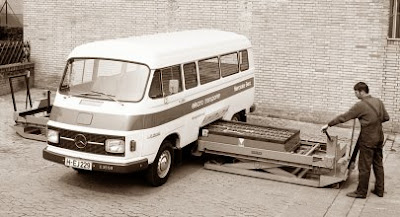
Shai Agassi, the chief executive of Better Place, which is building electric car infrastructure in Israel, Hawaii, Northern California and several other places, thinks electric cars should have batteries only. He proposes setting up swap stations where motorists on long trips could exchange a depleted battery for one fully charged.
"We just don't think that the answer to how to extend the battery is to put a power plant in our trunks," he said.You can see a computer simulation of the Project Better Place battery exchange station here.
I recently asked my EV wonk friends what they thought of the battery swap-out model, and I will reprint some of their answers below. I have never actually found anyone who thought it was a viable idea. Where, for instance, would it be done? Sunday's New York Times asserts:
-
The World Bank offers to loan developing countries the funds to pay for climate change adaptation
What would you say if someone drove a truck into your house, then jumped out and offered you a loan to help rebuild?
After you stopped screaming at them, which might take a while, you'd demand that they pay for damages that they caused, of course. Over time though, if no one forced the truck driver to pay for the damages, you might be tempted to take the loan. Sure, its a rip-off, but at least you get the money you need to rebuild.
This is exactly what's happening today with much needed funding for adaptation to climate change impacts in the developing world. The World Bank, backed by Northern taxpayers, is "offering" to loan the developing world the money needed to adapt to climate change impacts.
Ethically, this is abhorrent.
-
Two projects uniting veterans and green jobs
Two grassroots projects recently came to my attention aimed at finding green employment for vets, too many of whom return to no jobs, many bills, and much debt, creating an awful lot of strain on them and their families. Veterans Green Jobs was conceived to create "solutions for three of the most urgent issues of our time: the rebuilding of a sustainable green economy, reversing deteriorating environmental conditions and climate change threats, and the need to reintegrate over a million military service veterans from the Iraq and Afghanistan wars who are in need of healing and meaningful new careers."
And in San Diego, Archi's Acres Veterans Sustainable Agriculture Training program's three-month, 40 hour-per-week course offers returning vets both hands-on training and textbook learning in organic production, from seeds to sales. Started by ex-Marine Colin Archipley, a three-tour veteran of the Iraq war, it's making a big difference for its participants. Check this great story from a local TV network on its impact both in terms of new skills learned and the therapeutic effect of growing food:
Hats off to you, Colin.
-
A very cool 'only in California' development … bike valets
Slate V posted a short video about the bicycle valet service provided at the farmers market in Santa Monica, Calif.
Brilliant! But do the valets help repair flat tires?
-
-
Against the so-called 'need' for new long-distance, high-voltage transmission lines
The following is a guest post from Carol A. Overland, a utility regulatory attorney and electrical consultant based in Minnesota and Delaware, representing clients in energy dockets including transmission projects, wind, gas and coal gasification generation, and nuclear waste.
-----
 Transition ... transmission ... transition ... transmission ...
That old Bowie hook is on my mind as I represent individuals, community organizations, and local governments opposing high-voltage transmission lines. Today we're at a crossroads in energy, a transition point where the decisions we make, like electricity itself, are binary. What we choose will determine how we use electricity in the future. The first step is to carefully define "need."
Transmission doesn't produce electricity. It is passive infrastructure that just sits there, conducting energy from one place to another. At its worst, though, it's an enabler of dysfunctional energy planning and profit-driven projects that are against the public interest. Claims that we "need" transmission are end-stage conclusions of a many-step planning process that we as a society have not yet consciously begun.
"Need" is a term of art, and the crucial task for energy planners is to define the need. We need energy when we flick the switch, and when we do, that's a utility's need for service of local electrical load. We also need renewable generation, and we have an equally compelling need to reduce the CO2 emissions, pollutants, and toxic waste of electrical generation (a need not readily recognized in energy planning). Energy planners plan for peak "flick of the switch" need, those few very hot summer days or very cold winter nights. How much "flick of the switch" energy do we need? It depends.
Prior to assessing local load-serving need and making demand projections -- before "need" is considered -- the first and unarguably least-cost step is conservation. We can easily make up for an annual projected increase in demand of 1.5 percent through conservation, and can probably cut today's "need" by 10 percent or more, though compound conservation gets more difficult as we cherry pick the easy stuff. The next step before analyzing need is to enact energy efficiency, demand-side management, and load-shifting to cut the peaks and level out the dips. This is also a comparatively least-cost means of meeting demand.
When that's done, and not before, it's time to assess our need for electricity -- the supply side. Utilities, which are in the business of selling electricity and building their infrastructure -- for which we pay, routinely promote sales and exaggerate growth in demand. Because of their overstatements of need in similarly recessionary times, we overbuilt in the 1970s, to the extent that many proposed plants were ultimately canceled. Still so much was built that we haven't needed much utility infrastructure since. We've been through this before, and should be mindful in making investments.
-
Children are externalities
"So many people are wondering why, when our lives are supposed to be getting better, there are more and more babies born with birth defects and couples who are infertile."
-- Chinese environmental activist Huo Daishan, on the alarming rise in birth defects in his country
-
Civil disobedience campaign launched at Massey Energy mountaintop-removal site

"Give me but a banner to plant upon the mountains of West Augusta, and I will rally about it the brave men who will lift our bleeding country from the dust, and set her free."
-- George Washington, 1779
In Pettus, West Virginia this morning, five Coal River Mountain activists were arrested and charged with trespassing after locking themselves to a bulldozer and a backhoe at a Massey Energy mountaintop-removal mine site.
In the face of an impending 6,600 acre mountaintop removal strip mine, they planted a banner for the Coal River Wind Project, a nationally acclaimed proposal that would create 200 local construction jobs and 50 permanent jobs, enough energy for 150,000 homes, and allow for sustainable forestry and mountain tourism projects, as well as a limited amount of underground mining.
After the TVA coal ash disaster in December, when a billion gallons of coal ash poured out of a pond and deluged 400 acres of land in six feet of sludge, the Coal River Mountain activists fear blasting for the proposed mountaintop removal site on Coal River Mountain, which rests beside a 6 billion-gallon toxic coal waste sludge dam above underground mines, could be catastrophic for the communities downstream.
"Massey could flood the towns of Pettus, Whitesville and Sylvester with toxic coal sludge," said Julia Bonds, of Rock Creek, W.Va. "Blasting at a multi-billion-gallon sludge lake over underground mines could cause the sludge to burst through and kill thousands of people."
"The governor and county legislators have failed to act, so we're acting for them," Coal River Wind advocate Rory McIlmoil said. "They shouldn't allow the wind potential on Coal River Mountain to be destroyed, and the nearby communities endangered, for only 17 years of coal. There is a better way to develop the mountain and strengthen the local economy that will create lasting jobs and tax revenues for this county, and that's with wind power."
-
How to save the planet with heated clothing
 I spend a lot of time in a secret underground laboratory (basement workshop/office). It's my version of a Man Cave. In place of a big screen TV, pool table, and bar, it has (along with every power tool known to modern man) an oscilloscope, a table saw, and a box of red wine sitting on top my computer tower.
It's also completely unfinished (exposed studs) and unheated, with no insulation in the walls whatsoever. The temperature at my desk is presently 52 degrees and thanks to the thermal mass of the concrete walls and floor, will remain at this approximate temperature for the four coldest winter months. It's 39 degrees outside as I write. The cave analogy isn't too far off.
Staying warm while sitting on one's ass in front of a computer for hours on end in a 52 degree room can be challenging.
-
Why a cap without the trade is the worst of all worlds
As cap-and-trade legislation gets debated in Oregon and Washington, a worrisome lightbulb seems be going off for a number of folks. (Congressman DeFazio from Oregon, for example.) It goes like this: Instead of "cap-and-trade" how about just "a cap without the trade?"
Under this idea, we'd meet the terms of the cap through command and control regulation. There wouldn't be permits or a trading system (and hence no auctioning). To be sure, this will reduce emissions, which is a very good thing.
But in terms of fairness and inexpensiveness, let me be completely clear: This is a horrible idea.
For consumers and businesses who are already struggling to pay their energy bills, cap without the trade is actually worse than the very worst form of cap-and-trade. Plus, it misses out on almost all of the upsides of cap-and-trade done right.
In the worst form of cap-and-trade -- a "grandfathered' system, in which the government gives out permits to polluters for free -- consumers wind up paying massive windfalls to the big energy companies that get free permits. [Click here to learn why]. That's why we favor auctioned cap-and-trade, since it makes polluters pay for their permits -- and the public keeps the money. Auctioned cap-and-trade is fair, effective, and efficient.
But if you can believe it, cap-and-no-trade would actually be worse for consumers and businesses than a grandfathered system. Families would pay even more for energy, while Exxon and other big energy companies would get even bigger windfalls!
Here's why.
