Uncategorized
All Stories
-
Ah, the magic of cable
On Monday, I mentioned that Jon Stewart was dedicating this week's shows to evolution. What I didn't know at the time (but found out at 11:20 p.m.) was that Chris Mooney was that night's guest. We love Chris Mooney! We love Jon Stewart! What a combination.
Earlier, on his blog, Chris had described the upcoming interview -- part of his book tour -- as a "biggie." But the only sign of nervousness was that he couldn't quite decide what to do with his hands. (Frankly, if I were in the hot seat, I'd probably forget how to speak.) He did well, and even slipped in two (count them!) mentions of global warming. Now that's entertainment.
-
The Reality of Bites
Coastal Mississippi braces for resurgence of mosquitoes post-Katrina Of the 175-odd species of mosquitoes in the United States, 56 call Mississippi home, and eight to 10 in particular hang out […]
-
Pact Into a Corner
NE states face choice between nuclear power and greenhouse-gas emissions New Jersey and Vermont — two of nine Northeast states negotiating a pact to cap greenhouse-gas emissions — rely heavily […]
-
A Los Angeles Times story tars wetlands activists without telling the whole story
... or so you can imagine Michelle Malkin reworking the old lawyer joke with glee this past weekend, when a reader alerted her to "A Barrier That Could Have Been" in the Sept. 9 edition of the Los Angeles Times.
In a nutshell, the newspaper reported that in 1977, wetlands preservation activists successfully sued under the National Environmental Policy Act to stop the Army Corps of Engineers from building a massive hurricane barrier meant to protect New Orleans. They proved to a U.S. District Court judge that the Corps had failed to do a thorough evaluation of the project's possible environmental impacts. The St. Tammany Parish and local fishers had also opposed the project.
The LAT reporters wrote, "Now the question is: Could that barrier have protected New Orleans from the damage wrought by Hurricane Katrina?"
That's the wrong question.
-
Will Brits pull off another gas-price protest?
Looks like the U.S. isn't the only place where people are getting riled up at the pump. Fuel costs have shot up across Europe -- thanks in part to the effects of Katrina -- and protests are springing forth. This week, with prices in England reaching the equivalent of about $9 a gallon, the same folks who waged crippling fuel protests in 2000 are threatening to start a blockade tomorrow. Anxious Brits have responded by queueing up to fill their tanks.
Can I type queueing again? That was fun.
-
Condi’s coulda, woulda, shoulda
Over the last couple of weeks, Secretary of State Condoleezza Rice has used some careful (and chill-inducing) modal verbs to weigh in on the idea that race was a factor in the Katrina mess. Last week, she fumed that "Nobody, especially the president, would have left people unattended on the basis of race."
And yesterday, meeting with the New York Times, she acknowledged that race and poverty do still collide in this country. She added, "The United States should want to do something about that."
Yes. Shouldn't it?
-
Katrina and global warming, part zillion
Some recent pieces on the perennial topic of Katrina and global warming:
- In Slate, Paul Recer makes basically the same point Chip and I did in our op-ed: The science drawing a firm connection just isn't there yet, and anyway, there are plenty more immediate concerns on which environmentalists should be focused.
- On KatrinaNoMore.com, a whole website devoted to the subject, Mike Tidwell says global warming will lead to more New Orleans-style disasters, not so much because of stronger hurricanes as because of rising sea levels.
- In The New Yorker, the inimitable Elizabeth Kolbert gets the science basically right:
The fact that climbing CO2 levels are expected to produce more storms like Katrina doesn't mean that Katrina itself was caused by global warming. No single storm, no matter how extreme, can be accounted for in this way; weather events are a function both of factors that can be identified, like the amount of solar radiation reaching the earth and the greenhouse-gas concentrations in the atmosphere, and of factors that are stochastic, or purely random. In response to the many confused claims that were being made about the hurricane, a group of prominent climatologists posted an essay on the Web site RealClimate that asked, "Could New Orleans be the first major U.S. city ravaged by human-caused climate change?" The correct answer, they pointed out, is that this is the wrong question. The science of global warming has nothing to say about any particular hurricane (or drought or heat wave or flood), only about the larger statistical pattern.
If I have any criticism of Kolbert's piece, it's that she, like so many people commenting on this topic, focuses unduly on cutting CO2 emissions. But if our goal is to save lives, we could save a lot more, a lot faster, by focusing on shorter term demographic and political solutions. This is not to say that we shouldn't cut down on greenhouse gases -- we should -- just that doing so should be thought of as part of a larger package of severe-weather-disaster preparation and mitigation strategies.
(And yes, I really am on paternity leave. Pretend like this post never happened.)
-
Eco-vigilantes in France take on gas guzzlers, one tire at a time
Sounds like the SUV-loving citizens of France need TerraPass.
As reported by Wired: "A band of eco-vigilantes is taking a firm but gentle stand against fast-growing SUV sales in France and Europe, deflating the tires on gas guzzlers in a protest against conspicuous waste."
Why?
"We have to stigmatize SUVs by initiating a debate that will allow scientists and experts to publicly (declare) their hazards," said the spokesman, who spoke on the condition of anonymity. "We don't want SUVs to be seen as a sign of wealth, but something that is associated with an imbecile."
-
![]()
![]()
Walking It Off, Doug Peacock’s memoir, separates the man from the myth
Walking It Off by Doug Peacock, Ewu Press, 208 pgs., 2005. Think you know Doug Peacock? Think again. He was the inspiration for George Washington Hayduke, the hard-charging, Vietnam-scarred protagonist […]
-
![]()
![]()
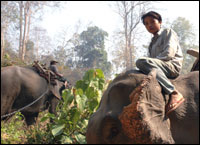
Logging keeps Asian elephants in business … for now
At a fork in the road, our guide points to the right. “That’s the main road there,” he says. “We’ll go on this smaller road, deep into the jungle.” A […]